




Sandra Mujinga

Lecture by Aaiún Nin
Thursday, May 21, 6 pm
Troisième Étage, Waldmannstrasse 6
RSVP here
Aaiún Nin is an Angolan mixed media artist, activist and author. Nin’s poetry draws upon the experience of childhood and youth spent in a patriarchal society and is strongly rooted in the context of postcolonial Africa. In their poems they often refer to the present situation in Angola, addressing problems of sexual violence inflicted on women, religious fundamentalism and the contradictions of Catholic doctrine, social inequalities and racism. Through their work, they explore and confront issues of race, gender and sexual discrimination, as well as LGBT+ experience. Their first poetry collection, Broken Halves of a Milky Sun was published in 2022 in the USA and has been translated into various languages. Their second collection of poems, Lithium Carbonate, is set to be published in 2026. On the occasion of this lecture, Nin will be reading from both publications.
–
Galerie Eva Presenhuber is pleased to present a group exhibition featuring works by Aria Dean, Sandra Mujinga, and Tschabalala Self. Working across the mediums of moving image, sculpture and painting, the artists explore the making and erasure of the body: Dean stages death without the dead, Mujinga sutures grief into spectral silhouettes, and Self reconstructs the figure through assemblage. Together, their works trace the architectures of modern violence, resisting spectacle while reconfiguring the terms of subjecthood.
Olamiju Fajemisin
Aria Dean
Leveraging traditions of architectural and literary modernism, Aria Dean’s two-part presentation features the immersive short film Abattoir U.S.A.! (2023) and the conceptual sculptural assemblage, Mambrino’s Helmet (2026). Despite their formal dissimilarities, the works converge on their critique of the structural logics embedded within their source materials. Marked by the absence of a stable human subject, both works refuse narrative closure and implicate the viewer within the systems they render visible.
Abattoir U.S.A.! explores the interior of an industrial slaughterhouse where there are no workers, no animals, and seemingly, no violence. Viewers experience the film — accompanied by Evan Zierk’s unnerving eight-channel score and produced using Unreal Engine, a 3D computer graphics tool used to create video game-like environments — from an uncanny first-person perspective. Moving through corridors, chutes and holding pens, the “camera” surveys a meticulously designed architecture of killing. Influenced by the philosophies of Georges Bataille and Frank B. Wilderson III, the artist conceives of the slaughterhouse as both an architectural invention and a conceptual paradigm: a “modernist solution” to industrialised killing, “cursed and quarantined like a plague-ridden ship,” per Bataille. Here, death is approached from a material rather than a symbolic perspective. As Dean does not represent death by showing images of the dead, but through depicting the infrastructure that makes death possible, Abattoir U.S.A.! interrogates how necropolitical structures underpin civil society while withholding the spectacle typically produced of such violence.
In contrast, Mambrino’s Helmet operates as a mythic readymade. Comprising a motorcycle helmet and sheets of foam held together with iron nails and tape, the sculpture refers to an episode from Miguel de Cervantes’ mock-epic ur-novel, Don Quixote (1605/1615), in which the deluded knight mistakes a barber’s brass basin — worn, in this instance, as a makeshift rainhat — for the enchanted golden helmet of the Moorish king Mambrino. By invoking this metafictional, mythic object, Dean mobilises one of the founding gestures of modern literature: the slippage between reality and interpretation. The world does not change — only the narrative imposed upon it.
Taken together, Abattoir U.S.A.! and Mambrino’s Helmet hinge on the absence of embodiment: a slaughterhouse without the slaughtered; a helmet without a wearer, and ultimately, magical powers. Refusing images of spectacular violence, Dean redirects attention toward the architectural, narrative and conceptual systems that structure how bodies appear, disappear, and are understood.
Aria Dean (b. 1993, Los Angeles, CA, US) lives and works in New York City. Dean has exhibited widely in the U.S. and internationally; recent exhibitions include Material Evidence at Fundação de Serralves, Porto, PT (2025); Facts Worth Knowing at Chateau Shatto, Los Angeles, CA, US; Figuer Sucia at Greene Naftali, New York, NY, US (2023); Abattoir, U.S.A! at the Renaissance Society, Chicago, IL, US (2023); and Quiet as It’s Kept: Whitney Biennial 2022 at The Whitney Museum, New York, NY, US (2022). Her writing has appeared in Artforum, E-flux, Spike Magazine, Art in America, Frieze, X-Tra Contemporary Art Quarterly, The New Inquiry, Texte zur Kunst and many other publications. Her films have been screened at the New York Film Festival, Villa Medici Film Festival, TIFF Cinematheque, ICA London, and Anthology Film Archives. Her most recent publication, a catalog for Abattoir U.S.A, was published in April 2025. Dean’s most recent work, The Color Scheme, a play for two actors co-commissioned by Performa and The Hartwig Foundation, premiered in New York City in November 2025 and travels to Berlin in summer 2026.
Sandra Mujinga
Sandra Mujinga’s work explores how bodies transform and persist in the aftermath of violence. With the Unfold and Repair (2024) series — a group of five fabric-based sculptural forms that blur the boundaries between figuration and abstraction — Mujinga explores themes of vulnerability, resilience, as well as the slowness of labour. Standing at varying heights, each work comprises a steel skeleton lightly padded with foam and draped in cerulean cotton. The skins of these spectral humanoids have been gathered and stitched by hand, foregrounding the meticulous labour of their construction. Installed in a room flooded with blue light, the sculptures appear to bleed into their monochromatic surroundings, dissolving the threshold between figure and environment.
Drawing on the writings of the American scholar Christina Sharpe — namely her hybrid work of criticism, memoir and cultural theory examining how Black life is remembered, witnessed and lived in the aftermath of the transatlantic slave trade, Ordinary Notes (2023) — Mujinga approaches the body not merely as an image to be captured, but as a site of encounter and repair. Here, fabric becomes a medium through which time is slowed. Rather than presenting trauma as a singular moment, Unfold and Repair evokes the cyclical nature of mourning in which the past repeatedly resurfaces within the present. For Mujinga, loss is not simply remembered, but continually re-experienced, as one grieves both what has been lost and what might have been.
Ultimately, Mujinga’s sculptures operate less as static objects than as repositories of feeling. Through acts of folding, draping and repair, fabric becomes a medium through which time is slowed, folded back upon itself, or momentarily held in suspension. Memory, care and endurance accumulate within the figures’ gathered seams, suggesting that to “unfold and repair” is not to erase damage but to live alongside it.
The figures appear uncannily human, yet they resist clear recognition, hovering somewhere between presence and disappearance. In doing so, Mujinga challenges the tendency for suffering bodies to be rendered as spectacle. Instead, these sculptures allow the body to remain partially concealed as a gesture of protection and self-preservation.
Sandra Mujinga (b. 1989 in Goma, DRC) lives and works in Berlin, DE and Oslo, NO. In 2026, her most comprehensive solo exhibition to date will take place at the Belvedere, Vienna, AT. In 2025, Mujinga participates at the Kochi-Muziris Biennale, Kochi, IN. In recent years, Mujinga has been the subject of important solo exhibitions at institutions including Stedelijk Museum, Amsterdam, NL (2025); Den Frie Museum of Contemporary Art, Copenhagen, DK (2025); Kunsthalle Basel, Basel, CH (2024); MdbK- Museum der bildenden Künste Leipzig, Leipzig, DE (2023); Hamburger Bahnhof, Berlin, DE (2022); Malmö Konsthall, Malmö, SE (2022); Sandefjord Kunstforening, Sandefjord, NO (2022); Munch Museum, Oslo, NO (2022); Gothenburg Art Museum, Gothenburg, SE (2021); and Bergen Kunsthall, NO (2019). She has participated in group exhibitions at institutions including PoMo, Trondheim, NO (2025); MACRO - Museum of Contemporary Art of Rome, Rome, IT (2024); Den Frie Museum of Contemporary Art, Copenhagen, DK (2024); DAS MINSK Kunsthaus in Potsdam, Berlin, DE (2024); Guggenheim Museum, New York, NY, US (2023); MoMA – Museum of Modern Art, New York, NY, US (2023); Moderna Museet, Malmö, SE (2022); Tønder Art Museum, Tønder, DK (2022). Mujinga’s work is represented in major museums worldwide, including the Stedeljik Museum of Modern Art and Contemporary Art and Design, Amsterdam, NL; the Astrup Fearnley Museet, Oslo, NO; and Museum of Modern Art, New York, NY, US.
Tschabalala Self
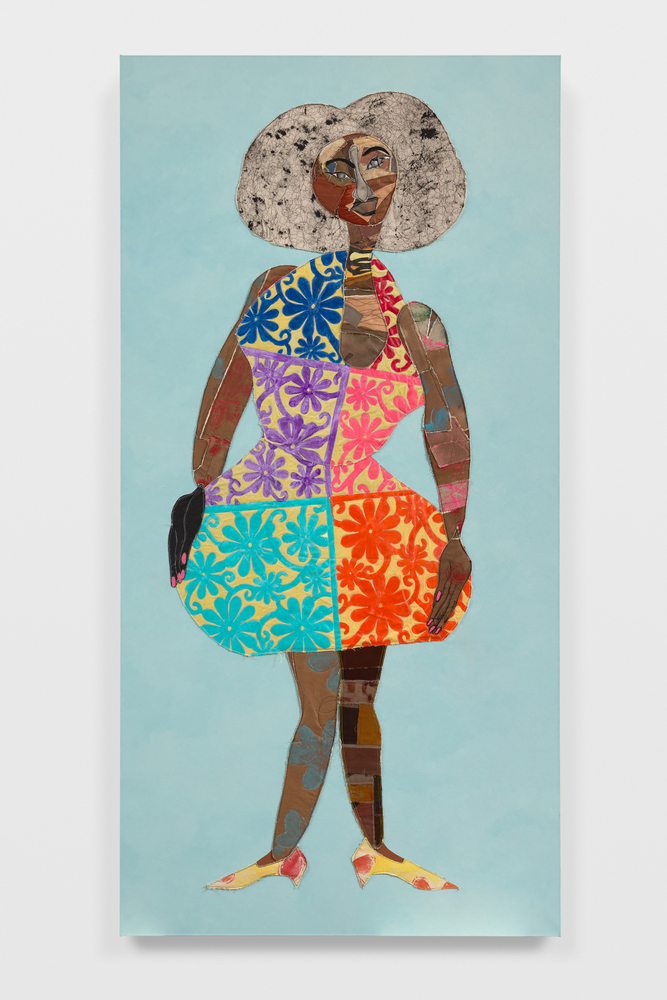
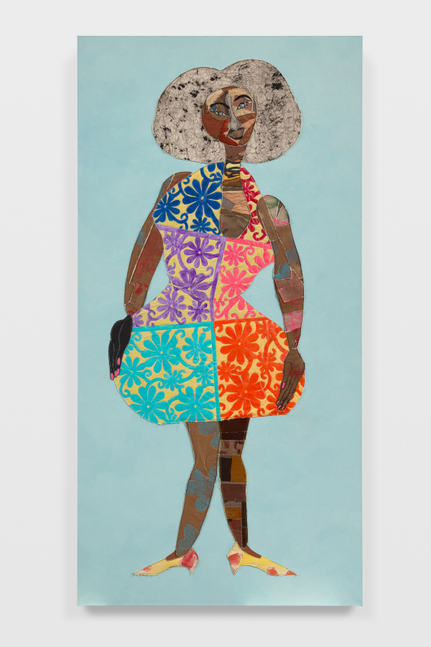
Of the artists in this exhibition, Tschabalala Self presents the most explicitly painterly position. Working across painting — that is, the application of acrylic and oil-based pigments to canvas — as well as collage, appliqué and stitching, Self constructs playful yet deliberate, larger-than-life figures of women. Echoing the logic of the Surrealist “exquisite corpse,” these bodies appear as though assembled from wholly disparate fragments. Through this process of assembly, Self explores how Black femininity is imagined and performed — a gesture that recalls the practices of her female ancestors and maternal figures, who sewed curtains and transformed old fabrics into garments.
In Diamond, Kitten and Wednesday (all 2026), Self realises full-length patchwork portraits of three Black women. Their femininity is expressed through the gendered connotations of their high heels, painted stiletto nails and neat coiffures. We know they are Black through Self’s manner of piecing together their skin — in Kitten, whose subject’s skin is made up of a mosaic of brown, beige and ochre scraps tattooed with red, pink and periwinkle paint, we understand that we are looking at a portrait of a Black woman. Moreover, patterned fabrics are stitched directly into the surface of the paintings, transforming clothing into structural components of the body itself. For Self, Blackness is not an aesthetic but a lived and spiritual reality that is articulated through the artistic approach of accumulation.
Whereas Dean and Mujinga insist on the absence or suspension of their figures, Self’s approach to figuration emphasises the body as something constructed, rather than simply depicted. Against saturated monochrome backgrounds, the figures appear placed in space, poised with theatrical self-possession. The seams, joins, and visible materials remain deliberately legible, emphasising Self’s direct engagement with the materials. In this sense, Self’s practice stages a reclamation of the body through acts of construction, allowing her subjects to occupy space with agency shaped by the artist’s hand.
The quilt-like structure of Self’s figures asserts the body as a pure construction, and reflects the shared human reality of having a body through the vehicle of the Black female form. By insisting on the presence of the body as something actively made and claimed, Self foregrounds figuration as an act of construction, rather than simply depiction.
Tschabalala Self (b. 1990 in Harlem, NY, US) lives and works in Upstate New York. Her upcoming projects in 2026 include a sculpture commission for the facade of New York’s New Museum, and the historic Fourth Plinth commission in London’s Trafalgar Square. Recent solo exhibitions in museums and public institutions include ESPOO Museum of Modern Art, Espoo, Fi (2024); FLAG Foundation, New York, NY, US (2024); Swiss Institute, New York, NY, US (2024); CC Strombeek, Grimbergen, BE (2023); Kunstmuseum St. Gallen, St. Gallen, CH (2023); Consortium Museum, Dijon, FR (2022); Baltimore Museum of Art, Baltimore, MD, US (2021); ICA Boston, Boston, MA, US (2020); Hammer Museum, CA, Los Angeles, CA, US (2019). Furthermore Self has participated in numerous group exhibitions at Museum of Fine Arts Houston, Houston, TX, US (2024); The Shah Garg Foundation, New York, NY; US (2023), Hammer Museum, Los Angeles, CA, US (2023); ARKEN Museum of Modern Art, Ishøj, DK (2022); Kunsthalle Duesseldorf, Duesseldorf, DE (2021); Haus der Kunst, Munich, DE (2021); Brooklyn Museum, New York, NY, US (2021), Hannover Kunstverein, Hannover, DE (2020); Irish Museum of Modern Art, Dublin, IE (2019); Rubell Museum, Miami, FL, US (2019); Philadelphia Art Museum, Philadelphia, PA, US (2019); Museum of Contemporary Art San Diego, San Diego, CA, US (2019); MoMA PS1, New York, NY, US (2019); Museum of Modern Art, Warsaw, PL (2019); Jewish Museum, San Francisco, CA, US (2019); Crystal Bridges Museum of American Art, Raleigh, AR, US (2018); Centre Régional d’Art Contemporain Occitanie/Pyrénées-Méditerranée, Sète, FR (2018); Trigger, New Museum, New York, NY, US (2017).
hidden
Diamond
2026
Gesso, acrylic, fast drying medium, varnish, oil, fabric, thread, painted
canvas on canvas
244 x 122 cm / 96 x 48 in
© Tschabalala Self
Kitten
2026
Gesso, acrylic, fast drying medium, varnish, oil, fabric, thread, painted canvas on canvas
244 x 122 cm / 96 x 48 in
© Tschabalala Self
Wednesday
2026
Gesso, acrylic, fast drying medium, varnish, oil, fabric, thread, painted
canvas on canvas
244 x 122 cm / 96 x 48 in
© Tschabalala Self
Mambrino's Helmet
2026
Motorcycle helmet, foam, iron nails, tape
Approx. 56 x 61 x 56 cm / 22 x 24 x 22 in
© Aria Dean
Unfold and Repair
2024
Cotton, steel, foam; 5 parts
Figure 1 280 x 70 x 70 cm / 110 1/4 x 27 1/2 x 27 1/2 in
Figure 2 280 x 70 x 70 cm / 110 1/4 x 27 1/2 x 27 1/2 in
Figure 3 260 x 70 x 70 cm / 102 3/8 x 27 1/2 x 27 1/2 in
Figure 4 230 x 70 x 70 cm / 90 1/2 x 27 1/2 x 27 1/2 in
Figure 5 200 x 70 x 70 cm / 78 3/4 x 27 1/2 x 27 1/2 in
© Sandra Mujinga
Abattoir, U.S.A.!
2023
Single-channel video
10:59 min
© Aria Dean
